Children's House Montessori
Elementary Program
Elementary Program:
Students between 6 and 12 years of age are entering a new stage of development. The absorbent mind of the younger child is evolving into a conscious mind. Elementary students are interested in reasons, explanations, and the perspective of time; they love grand ideas and lofty concepts-the bigger, the better. They are eager to explore. Students of elementary age have developed a sure sense of what is real and now enjoy using their imaginations to explore things that they cannot experience concretely, such as other cultures or big ideas. The concrete, manipulative work of the pre-school Casa program naturally gives way to more abstract, intellectual work.
Elementary students are also more aware of their peers, community, and global issues. They are less focused on physical order and more interested in a moral sense of order. They have a strong sense of justice, fairness and rules.
Elementary students are interested in working in groups and often display a "herd instinct." They associate with others not merely for the sake of company, but also as a sort of organized activity. A leader is chosen and obeyed, and a strong group is formed. The multi-age Montessori Elementary classroom encourages this social development, and the adult moderates the process.
In addition to a classroom and a method of teaching that encourages cooperation and exploration, the international Elementary Montessori curriculum taps into the natural sensitivities of this age to create an energy that animates Elementary education. Each year, five great stories are told in a dramatic fashion to create a framework of information to which students will add detail and understanding throughout their elementary years. The story of the beginning of the universe, of life on the Earth, of human life and of the great human creations of language, mathematics and science creates a broad framework that invites students to explore all the traditional curricula (the sciences, history and geography, as well as mathematics and language), creating greater depths of understanding each year.
The technical aspects of language, mathematics and geometry (grammar, spelling, verb tenses, math facts, mathematical operations and facts, geometry constructions, etc.) are layered onto this curriculum, benefitting from the students' natural curiosity and desire to master their world. These skills are supported with materials and exercises that continue the sequence begun in the Casa program. The sequence of materials gradually directs the students into abstraction and working on paper. The Montessori curriculum encourages depth of understanding, creative thinking, problem solving, collaborative effort and mastery.
THE ELEMENTARY CURRICULUM
Cosmic Education is a cornerstone of the Montessori Elementary philosophy.
At its core, Cosmic Education tells the story of the interconnectedness of all things. It describes the role of education as comprehensive, holistic and purposeful; to encompass the development of the whole person within the context of the universe. It also introduces the possibility that humanity might have a "cosmic task," to better the world for future generations.
Dr. Maria Montessori believed that Cosmic Education was vital to early education because it provides children with a framework to understand their world and their place within it. Children learn to respect studies of the past, develop an understanding of ethics, and value the contributions of others. In this way, Cosmic Education teaches children to become aware of the interdependence of all things and develop a sense of gratitude that comes from that awareness.
Within the Montessori classroom, Cosmic Education forms a platform for teaching children to understand and adapt to their environment. In the first plane of development (0-6), Cosmic Education introduces the child to the natural world through experiences with nature and the sensorial learning materials. These experiences teach children to refine their senses and thus the way they process and understand their world. These skills aid the child's development and confidence in themselves, their society, and their world.
In the second plane of development (6-12), Cosmic Education introduces the child to the repeating natural cycles in our world, the fundamental needs that all humans share, and the connectedness of all living things. In the elementary years, children begin to draw connections between how each particle, substance, species, and event has a purpose in the development of all others. These "Great Lessons of Cosmic Education" are taught as a whole curriculum to show children how all content areas, such as the study of history, culture, science and the environment, are all interconnected.
Dr. Maria Montessori believed that children who received a Cosmic Education in childhood were better prepared to enter adolescence as independent, socially responsible, and emotionally intelligent individuals. This is because Cosmic Education launches children into the world with a practiced understanding of who they are as individuals, as members of humanity, and as citizens of the universe. It also provides children with a deep understanding of their moral responsibility to address global issues that affect humankind and the environment. In Montessori, every moment is an opportunity to understand the integrity of the universe.
Why is Cosmic Education important today?
Dr. Maria Montessori believed that the world was a purposeful place and that war, poverty, and injustice were deviations from that purpose. She believed that Cosmic Education was a way to restore harmony and order and thus allow humankind to realize its true potential. In the twenty-first century, global awareness, peaceful communication, and ethical cooperation are integral to resolving global disputes. By providing children with a Cosmic Education, Montessori empowers students with the knowledge to transform the world. As Dr. Maria Montessori stated: "The child is both a hope and a promise for mankind."
French
It is well known that children acquire languages more easily than adults, so our Elementary French language program takes the oral foundation started in Toddler and Casa and builds on it. As well as continuing with the oral language, this is the stage where the students begin reading and writing in French. We use the AIM method to achieve this. AIM (Accelerative Integrated Method) is a foreign language teaching method that uses music, dance, gestures and theatre to support learning.
When using AIM to teach French, hundreds of essential French words are taught alongside gestures, which are then combined with storytelling, theatre, music, and dance, to help students remember and speak the new vocabulary.
Children in Elementary will receive at least 90 minutes of French instruction weekly. The children will also be exposed to French conversation daily in the classroom, outside during recess and Phys Ed class and after school program, as French-speaking teachers communicate with one another and the children.
Physical Education
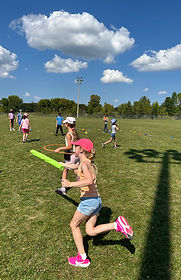
The elementary students participate in a physical education program for a minimum of two and a half hours each week. Typically, this program is held outdoors. Your child will have outdoor Phys. Ed thirty minutes each day, weather permitting. On rainy days, indoor yoga or dance instruction takes place. Your child will require running shoes and comfortable clothing. Our Phys Ed Program also includes a 12-week skating program, a 6-week skiing program, and a rotation of lessons in a variety of other fun activities.
Music/Art/ Drama
The Arts are an important part of our daily work in the Elementary classroom. Follow-up work to lessons can take the form of songs, plays or visual art. We sing daily, and the Montessori bells and tone bars are available to use every day. The Elementary class practices and performs a musical play for the school community each December. The role of artwork in the elementary classroom is an essential piece of self-expression and serves to direct coordination and concentration. The elementary child begins to care more about the product, creating art for the final masterpiece. The elementary child now begins to come to the realization that art is a skill that requires practice and repetition, and with practice comes improvement and immense satisfaction.
.jpg)
.jpg)